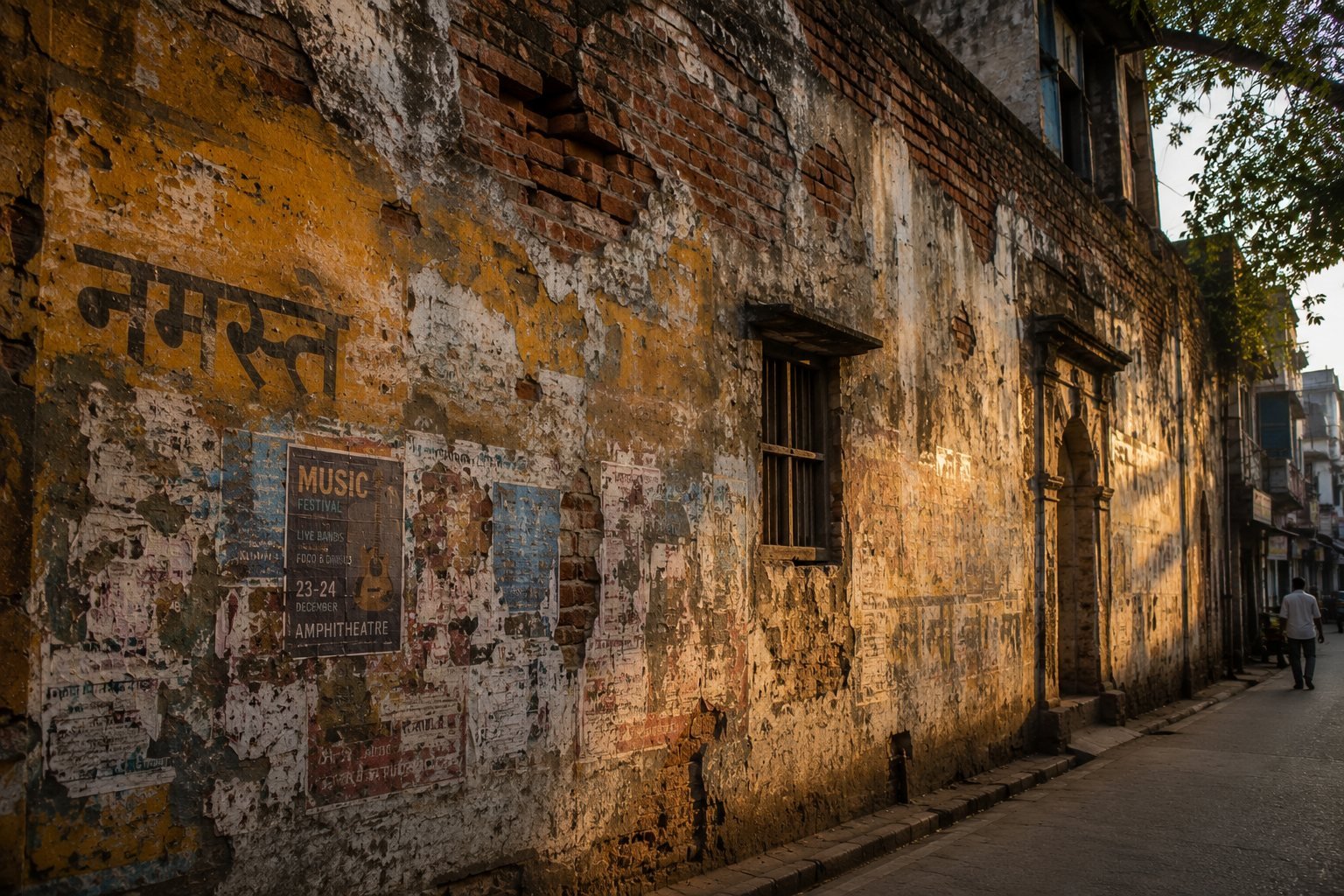
Somewhere underneath all of this — the mustard-yellow paint gone the color of turmeric left too long in the sun, the exposed brick where an entire chunk of plaster simply gave up and fell away, the dozen overlapping layers of posters advertising events that have long since happened and been forgotten — there is a single word painted by hand, decades ago, in letters large enough that it still reads clearly even now: Namaste. A greeting, offered to a street, by whoever owned this building back when its walls were freshly plastered and this word was the newest thing on them.
Everything painted or pasted on top of that greeting since then tells its own small piece of the building’s story. A poster for a two-day music festival, live bands, food and drinks, an amphitheatre — bright enough that it must have gone up only a season or two ago, already starting to peel at one corner the way every poster here eventually does. Beneath it, ghost-outlines of older notices, torn down to bare paper, their messages lost except to whoever happened to read them the week they mattered. A wooden-barred window, painted over so many times the bars themselves have thickened with paint into soft, rounded shapes. An old stone archway doorway, its carved detail still faintly visible under a century of grime and weather, leading into whatever this building has become now — a shop, most likely, or a home, or both at once, the way old-city buildings so often are.
This is what happens to a wall that nobody ever tears down and nobody ever fully restores. It just keeps accumulating — a coat of paint here, a poster there, a crack that gets noticed and then, more often than not, simply left — until the surface itself becomes a kind of visible timeline, each layer a rough marker of some year, some owner, some event that felt urgent enough to announce to the street at the time.
A man walks past in the frame’s far corner, moving briskly, clearly not stopping to look — and there’s no reason he should. He has probably walked past this exact wall thousands of times. It’s not a landmark to him, not something a guidebook would send a tourist to see. It’s just the side of a building on his way to wherever he’s actually going, background texture in a city he knows too well to notice anymore.
But stand in front of it for a few minutes, the way a stranger with a camera eventually will, and it stops being background. Every crack becomes a question. Every faded poster becomes a small, unanswerable mystery — who went to that festival, and did they enjoy it, and do they still remember it happened at all? Cities are usually described in terms of what gets built next: new towers, new roads, new glass-fronted stores replacing whatever stood there before. But some of the truest history of a place isn’t in what gets built. It’s in what gets left standing long enough to be painted over, and over, and over again — a wall that stayed, quietly keeping every layer of a city’s memory exactly where it fell.